Why People with ADHD Burn Out Faster at Work
(And It's Not About Effort)
Picture this: it's 5 PM on a Wednesday. You haven't missed a single meeting, you answered every Slack message, you pushed through the afternoon slump, and you still feel like you ran a marathon in someone else's shoes. Your neurotypical colleague closes their laptop and heads out for a run. You're lying on the couch wondering if you'll ever feel rested again. If that sounds familiar, you're not imagining it. You're not "too sensitive." You're not lazy. You're running a different operating system in an environment that wasn't built for it.
Here's what's actually going on.
A Nervous system problem
ADHD burnout isn't a character flaw. It's what happens when a nervous system that's already working overtime has no room left to recover. For many people with ADHD, a significant part of every workday goes to things neurotypical colleagues do on autopilot: self-monitoring their behavior, masking impulsivity, recalibrating focus after every interruption, and overcompensating to appear "on top of things." That's a full second job running in the background, all day, every day. Research on adults with ADHD consistently shows higher levels of burnout, emotional exhaustion, and cognitive weariness compared to neurotypical peers, with executive function deficits playing a key mediating role.
Why The Modern Workplace Drains You
Most offices and remote setups are poorly suited to how an ADHD brain works:
Vague instructions and distant deadlines often remove the urgency that helps ADHD brains activate. No stimulation means maximum cognitive drain just to start a task.
Constant task switching (meeting to email to Slack to back to work) means the brain never fully resets. Each switch tends to cost more energy than it does for a neurotypical brain. Research by Rubinstein, Meyer, and Evans found that task-switching can cost up to 40% of a person's productive time due to cognitive load,² and for ADHD brains, studies show the switch cost is compounded: slower transitions and more errors, especially when tasks require holding multiple instructions in working memory.³
Routine admin tasks can, for many people with ADHD, be harder than complex creative work. Boring, repetitive tasks often offer little dopamine, and the brain can fight itself the whole way through. That's not laziness. That's neurobiology backed by dopamine pathway research showing that ADHD brains have lower reward-system activation during low-stimulation tasks.
The Adrenaline Trap
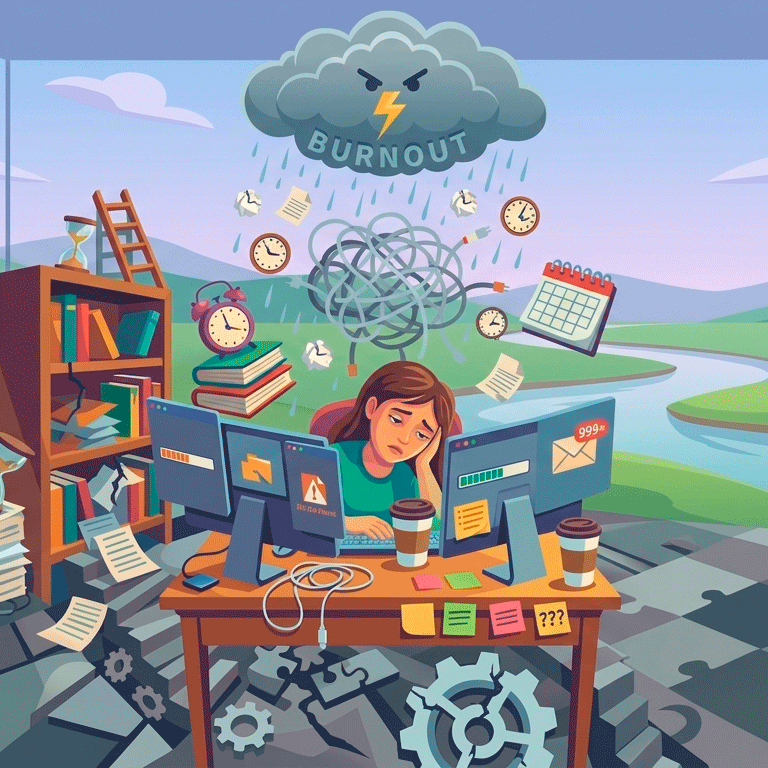
Here's a pattern a lot of ADHD folks fall into without realizing it: push through the energy dip, ignore the crash signals, rely on deadline adrenaline to get through. It works, until it doesn't. The problem is that using stress hormones as a productivity hack isn't sustainable. Eventually, burnout hits hard, and it takes much longer to recover than a regular bout of tiredness.
The Productivity Lie
Modern productivity culture sells one story: work smarter, not harder. Wake up earlier. Use the right app. Build a better morning routine. Optimize your system. And if you're still struggling? That's on you.
This narrative is especially harmful for people with ADHD, because it assumes the baseline is the same for everyone. It isn't.
"Hustle harder" only works when your brain isn't already spending significant energy just keeping up appearances. Productivity frameworks built around discipline, consistency, and long-horizon planning often run against how an ADHD nervous system operates. They create a cycle where you try the system, the system doesn't fit your brain, you blame yourself for the failure, you try harder, and you burn out faster.
The lie isn't that productivity doesn't matter. The lie is that there's one right way to be productive, and anyone who can't follow it just isn't trying hard enough. That's not a motivation problem. That's a design problem.
Real productivity for an ADHD brain often looks different. It tends to be interest-driven, urgency-triggered, highly context-sensitive, and deeply dependent on the right environment. That's not a weakness. That's just how this brain works, and building around it instead of against it is what actually moves the needle.
What You're Actually Spending Energy On
On a normal workday, a person with ADHD might also be doing some or all of the following:
Monitoring whether they're talking too much or too little in that meeting
Suppressing the urge to interrupt or switch tasks
Rebuilding context every single time they get pinged
Performing focus when their brain keeps trying to wander
Managing shame when a task didn't get done the "right" way
That's a five-layer cognitive load that most people around them never see. So yes, you're spending more energy to do the same job. And that is a structural problem, not a personal one.
What Actually Works
Understanding the root cause changes how you approach solutions. A few things that make a real difference:
Clear, specific tasks with near-term deadlines tend to provide the activation signal an ADHD brain needs.
Protected deep work blocks reduce the cost of task switching.
Environments that reduce masking pressure lower the background energy drain significantly.
Tools that work with your brain's need for stimulation and structure, rather than forcing a one-size-fits-all system.
This is exactly the gap NoPlex was built to address: a productivity system designed for how ADHD brains actually work, not how we wish they did.
If This Sounds Like You
If you manage people, this matters for your team. If you're navigating this yourself, know that the fatigue is real, it's documented, and it's not a reflection of your capability. It's a reflection of how much invisible work you're doing every single day.
The goal isn't to work harder. It's to stop wasting energy on systems that were never built for you.
For more helpful insights and tools designed with ADHD in mind, keep following NoPlex. We're here to help make life more manageable and meaningful.
This article is for educational purposes only and does not replace professional medical or mental health advice. Clinical evaluation and individualized care decisions should be made in collaboration with qualified healthcare professionals. If you are dealing with thoughts of self-harm or feel unsafe, consider seeking immediate professional or crisis support.
References
Gao, J. et al. (2024). "Executive function deficits mediate the relationship between ADHD and burnout in working adults." PLOS ONE / PMC. https://pmc.ncbi.nlm.nih.gov/articles/PMC11007411/
Rubinstein, J.S., Meyer, D.E., & Evans, J.E. (2001). "Executive Control of Cognitive Processes in Task Switching." Journal of Experimental Psychology: Human Perception and Performance. American Psychological Association. https://www.apa.org/topics/research/multitasking
Menzies, M. (2025). "Task Switching With ADHD: What Research Tells Us." LinkedIn. https://www.linkedin.com/pulse/task-switching-adhd-what-research-tells-us-matthew-menzies-abtcf
Volkow, N.D. et al. (2009). "Deficits in Brain's Reward System Observed in ADHD Patients." Brookhaven National Laboratory / NIH. https://www.bnl.gov/newsroom/news.php?a=110998