
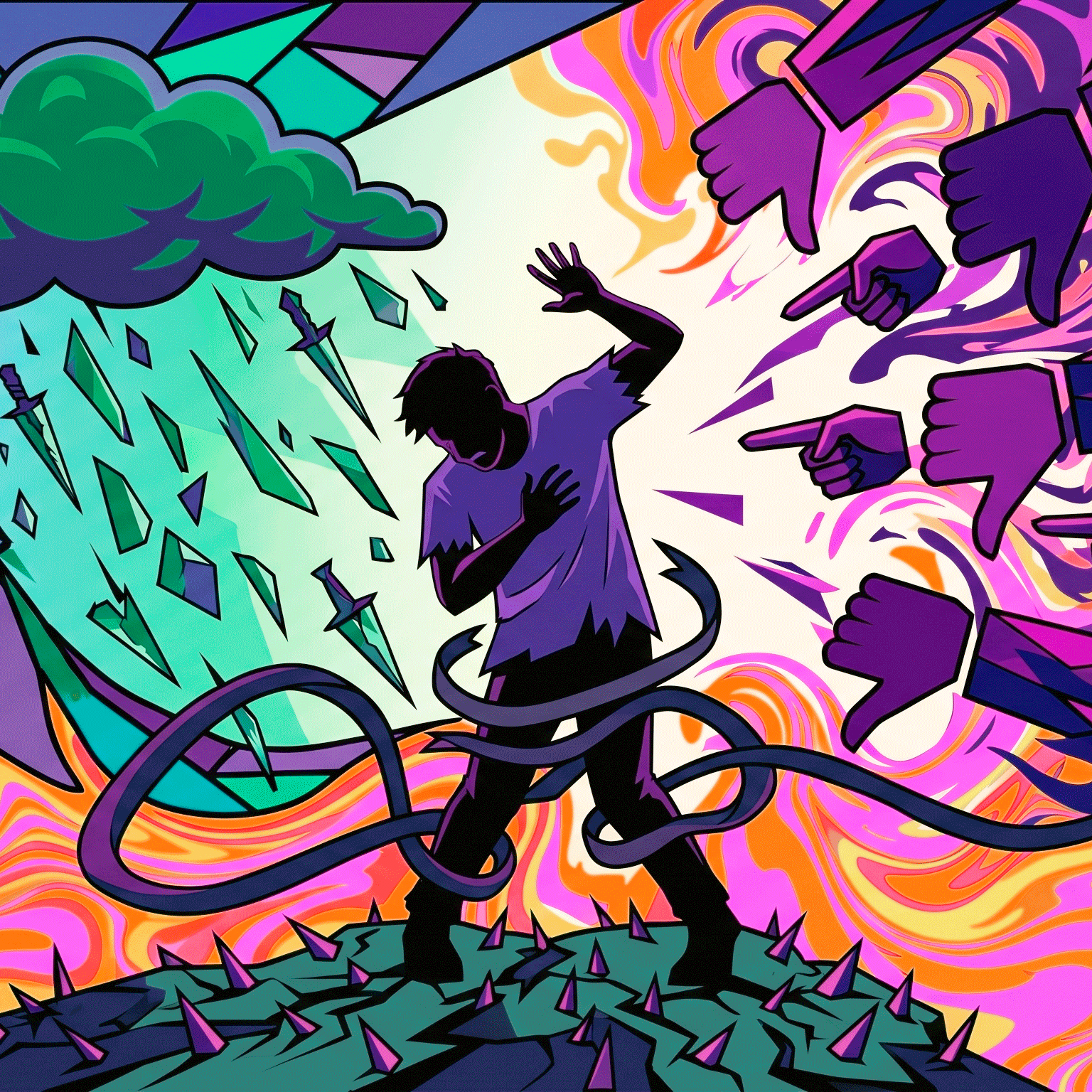
Why ‘Don’t Take It Personally’ Doesn’t Work for ADHD Brains
The email lands. Your heart sinks.
You see a short message from your boss.
No emojis. No “hey!” Just: “Can we talk later?”
Before you’ve even opened the email, your stomach has dropped, your chest is tight, and you’re running through every mistake you might have made. A friend’s delayed reply, a partner’s change in tone, a colleague’s unread message can set off the same spiral.
If you live with ADHD, this experience might feel painfully familiar. Many adults with ADHD describe a kind of emotional whiplash around perceived criticism or rejection, often called rejection sensitive dysphoria (RSD). Their bodies seem to overreact long before their brains have had a chance to think.
This article unpacks why that happens, why it’s especially common in late‑diagnosed women, and how a simple 11‑second pause can give your thinking brain a fighting chance.
Your Nervous System Is Faster Than Your Thoughts
When your brain detects a threat, it doesn’t wait for a long meeting with your prefrontal cortex (the part involved in planning, reasoning, and perspective‑taking). Instead, it runs an ancient script that kept our ancestors alive.
At the center of that script is the amygdala, a small almond‑shaped structure that rapidly tags things as “safe” or “danger.” Research shows that the amygdala can learn and express threat responses very quickly, in fractions of a second, before you have conscious awareness of what you’re reacting to. It sends signals through your nervous system that:
Increase heart rate and blood pressure;
Redirect blood flow toward large muscles;
Sharpen attention toward anything that might confirm the threat;
This “fight‑or‑flight” cascade also activates the hypothalamic–pituitary–adrenal (HPA) axis, telling your adrenal glands to release stress hormones like cortisol. Cortisol doesn’t peak in 11 seconds; it rises over several minutes and can stay elevated when stress is ongoing. But the key point is that your body responds within seconds, while your conscious mind is still catching up.
For many people with ADHD, this threat system appears to be more easily activated and sometimes reacts more strongly to stress. In one study, adults with ADHD showed higher cortisol reactivity to a stressful task than adults without ADHD, indicating a more pronounced stress response. Other research suggests that people with ADHD can have altered patterns of cortisol release in response to psychosocial stressors, even when their baseline levels look similar to neurotypical controls.
So when that email lands or your friend leaves you on “read,” your body is not being dramatic. It is doing what it was built to do: respond fast.
ADHD And Emotional Dysregulation: Why Feelings Feel So Big
Over the last decade, psychologists have increasingly recognized that emotional dysregulation is a core part of ADHD, not just a side effect. Emotional dysregulation means difficulty modulating how strongly and how long you feel emotions, especially in response to relatively small triggers.
Studies suggest that between 34% and 70% of adults with ADHD struggle with significant emotional regulation challenges. Brain‑imaging research offers two important clues:
The amygdala in ADHD often shows differences in size and activation, which may contribute to stronger emotional reactions to perceived threats or criticism.
The prefrontal cortex, which normally helps evaluate context, delay reactions, and choose a more proportional response, tends to show lower activation in ADHD, especially under stress.
In other words, the alarm system is louder and the brakes are weaker.
This is exactly what many people with ADHD report in daily life: emotions that shift rapidly, feel “all or nothing,” and are hard to cool down once triggered. Workplace conflicts, missed deadlines, and relationship misunderstandings can all hit harder and linger longer.
What Is Rejection Sensitive Dysphoria?
Rejection sensitive dysphoria (RSD) is a term coined by psychiatrist William Dodson to describe the intense emotional pain that many people with ADHD experience when they perceive rejection, criticism, or failure. It is not an official diagnosis in the DSM‑5, but clinicians and ADHD organizations widely recognize it as a useful way to talk about a very real pattern.
People who experience RSD often describe:
Sudden waves of shame, worthlessness, or rage after a perceived slight
Replaying conversations for hours or days, searching for proof they said or did the wrong thing
Avoiding opportunities (promotions, relationships, creative projects) because the possibility of failure feels unbearable
Importantly, the rejection does not have to be real. A delayed text, a neutral email, or even imagining that someone might be disappointed can trigger the same physiological and emotional storm as outright rejection. For an ADHD brain, “maybe they’re upset with me” can feel almost indistinguishable from “they definitely hate me.”
Why This Hits Late‑Diagnosed Women So Hard
In recent years, ADHD diagnoses among women have risen significantly as awareness has grown and diagnostic criteria have started to better capture the “quieter” presentations of ADHD. A large study of U.S. health records found that diagnoses in adult women increased markedly between 2003 and 2015, narrowing (though not closing) the historical gender gap.
Many women and AFAB (assigned‑female‑at‑birth) people are diagnosed only in adulthood, after years of being labeled “too sensitive,” “dramatic,” “lazy,” or “inconsistent.” Their ADHD often showed up less as visible hyperactivity and more as:
Chronic internal anxiety
Perfectionism and people‑pleasing
Emotional overwhelm and shutdown
RSD slots painfully into this history. If you’ve spent years masking your struggles, picking up micro‑cues in other people’s tone, and trying not to be “too much,” your threat system has been in training the whole time. It learns that social rejection is dangerous, especially in workplaces or families where conflict felt risky.
So when someone says “don’t take it personally,” what they’re really bumping into is not a fragile ego; it’s a nervous system that has been built, over decades, to take interpersonal signals very personally in order to stay safe.
The 11‑Second Pause: Giving Your Brain Time To Arrive
Your carousel suggests a simple but powerful idea: when your internal alarm goes off, give yourself about 11 seconds for your thinking brain to catch up. That specific number is more of a helpful frame than a precise biological timer, but it maps onto something research‑backed: short, intentional pauses can interrupt automatic reactions and shift your physiology.
Here’s one way to practice it, adapted from ADHD‑friendly breathwork techniques:
Notice the alarm: Name it in your head: “I’m activated,” “RSD is here,” or simply “Ouch.” Labeling emotions has been shown to reduce amygdala activation and support regulation.
Hand on chest: Place a hand on your chest or upper abdomen. This adds grounding sensory input and reminds your body you’re physically safe.
Count your breath: Breathe in through your nose for a count of 4, and out through your mouth for a count of 6–8. Do this slowly until you reach roughly 11 seconds (or longer if you can).
Delay the reply: If possible, wait before answering the email, text, or comment. Even a one‑minute delay can allow more prefrontal‑cortex involvement in what you choose to say.
This isn’t about suppressing feelings or pretending nothing happened. You are not stopping the reaction; you are letting your mind reach your body so you can choose a response that actually serves you.
Regular short practices like guided meditations, breathwork with counting, or micro‑breaks throughout the day can train this pause so it feels more available in the moment. ADHD‑friendly approaches that use structure, audio guidance, or movement tend to work better than “sit still and clear your mind” instructions.
Why “You’re Overreacting” Misses The Point
When someone tells you “you’re overreacting” or “this is all in your head,” they’re unintentionally skipping over the biology. From the outside, your response might look disproportionate to the situation. From the inside, your nervous system has already:
Scanned for threat,
Tagged the situation as dangerous (often based on old experiences)
Deployed adrenaline and cortisol.
By the time you’re told to “calm down,” the horse has already left the barn. Dismissing the reaction adds a second injury: feeling ashamed for something your brain and body did to protect you.
Partners and friends usually aren’t trying to be cruel; they often simply haven’t been taught how ADHD and rejection sensitivity work. Psychoeducation can help them understand that your reaction isn’t a choice, but your response can be, especially when you’re supported rather than shamed.
For loved ones, skills like active compassion, validating the feeling (“I can see this really hurts”), and offering co‑regulation (sitting together, breathing, holding hands) are far more effective than advice like “just ignore it.”
Building a kinder toolkit for “big feelings”
No single trick will erase RSD or emotional dysregulation, but many ADHDers find relief in a combination of strategies:
Therapy and coaching: Modalities like CBT, DBT, or emotion‑regulation skills training can help you identify triggers, reframe automatic thoughts, and practice new responses.
ADHD‑informed care: Medication, ADHD‑savvy therapy, and tailored productivity tools can reduce overall stress load, which in turn makes emotional storms less frequent and less intense.
Mindfulness that actually fits ADHD: Short, guided, or movement‑based practices (like walking meditation or breath counting) are often more realistic than long silent sits and can measurably reduce stress.
Nervous‑system hygiene: Sleep, movement, blood‑sugar regulation, and sensory supports (like noise‑canceling headphones or changing environments) all influence how jumpy your threat system feels on a given day.
Digital tools designed specifically for ADHD can also help you remember to take these micro‑breaks, schedule short regulatory practices, and track which strategies work best for you.
You are not “too much.” You are trying to survive.
If you’ve spent years being told you’re overreacting, it can be easy to internalize the idea that your feelings are the problem. The emerging science around ADHD, emotional dysregulation, and rejection sensitivity tells a different story: your brain and body are wired to protect you quickly, sometimes at the cost of accuracy.
Learning about that wiring doesn’t magically make the pain go away, but it does offer something powerful: context. That email that made your chest tighten? That text your friend didn’t answer? They’re tapping into a highly tuned survival system, not a character flaw.
The next time your body “gets the email before your brain does,” try offering yourself curiosity instead of criticism. Take those 11 seconds. Let your hand rest on your chest. Breathe. Then let your thinking brain join the conversation your nervous system has already started.
You deserve tools, support, and relationships that understand how your brain works. You’re not overreacting. You’re reacting fast. And with practice, you can learn to steer what happens next.
For more helpful insights and tools designed with ADHD in mind, keep following NoPlex. We're here to help make life more manageable and meaningful.
This article is for educational purposes only and does not replace professional medical or mental health advice. Clinical evaluation and individualized care decisions should be made in collaboration with qualified healthcare professionals. If you are dealing with thoughts of self-harm or feel unsafe, consider seeking immediate professional or crisis support.
References
American Psychological Association. “Emotional dysregulation is part of ADHD. See how psychologists are helping.” APA Monitor, 2024.
Soler‑Gutiérrez J, et al. “Evidence of emotion dysregulation as a core symptom of adult ADHD.” PLoS One, 2023.
UCLA Health. “Cortisol secreted during stressful situations.” 2024.
PubMed review: “Cortisol response to acute psychosocial stress in ADHD compared with other conditions.” 2021.
Van der Meere J, et al. “Psychological and cortisol reactivity to experimentally induced stress in adults with ADHD.” Psychoneuroendocrinology, 2015.
Goh PK, et al. “Emotional Dysregulation in Emerging Adult ADHD: A Key Consideration in Explaining and Classifying Impairment and Co‑Occurring Internalizing Problems.” Journal of Attention Disorders, 2024.
Dodson WW. “Over‑reaction: Rejection Sensitive Dysphoria in ADHD.” Attention Magazine (CHADD), 2016