
Time Blindness:
Why Your Internal Clock Runs Differently
Time blindness isn't bad time management. It's a neurological difference in how your brain perceives time passing.
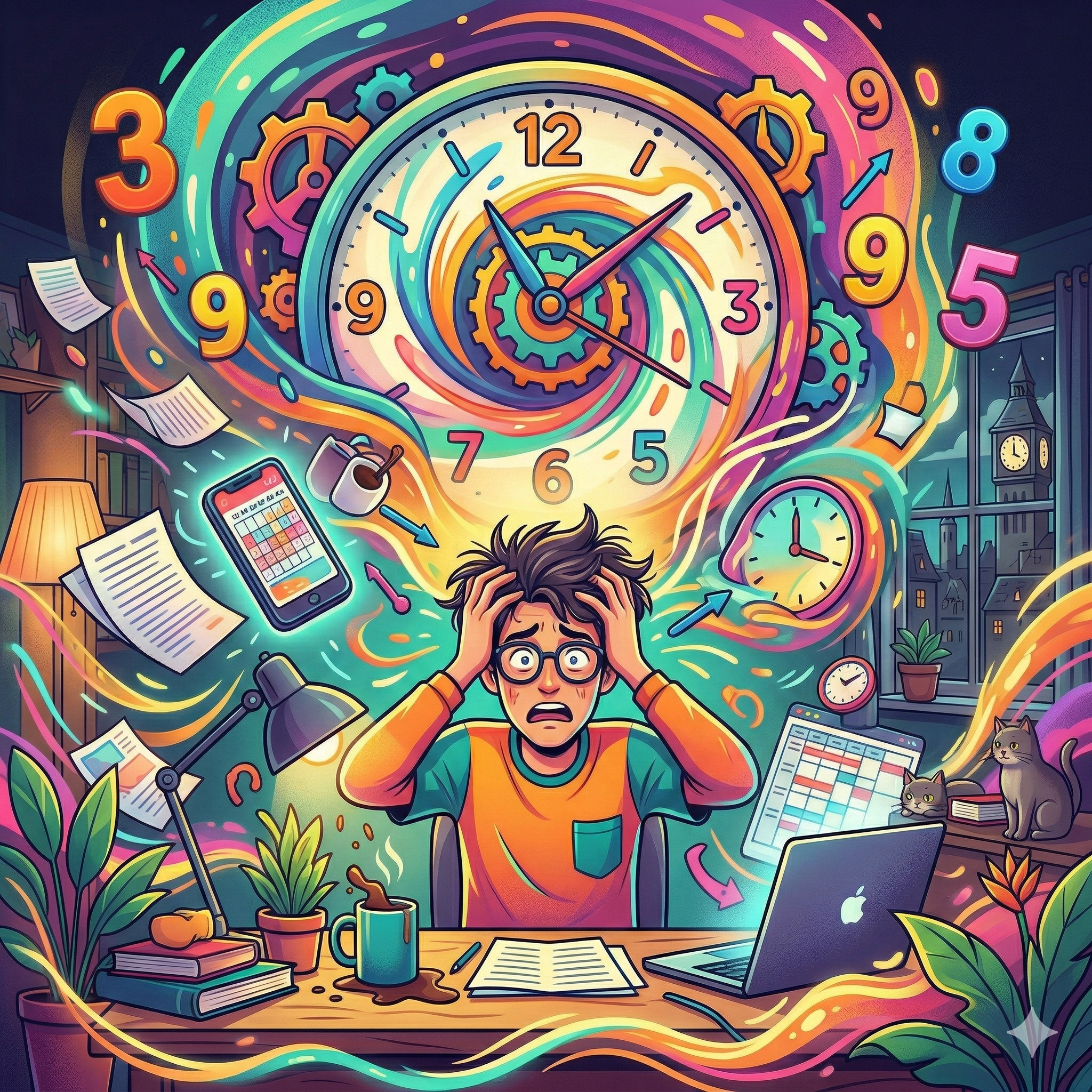
You estimate "plenty of time" and suddenly you're late. Or you hyperfocus for what feels like 20 minutes but 4 hours vanish. Your brain's time-tracking system isn't giving accurate feedback.
The Science Behind It
Time Perception Uses the Prefrontal Cortex: The same PFC region that handles executive function also processes time perception. When the PFC has reduced activity (as it does in ADHD), time perception suffers.
Brain Regions Involved: Research using brain imaging shows that time processing involves the prefrontal cortex, anterior cingulate cortex, supplementary motor area, and even the cerebellum. Any disruption in these networks affects how accurately you perceive time's passage.
Working Memory's Role: Your working memory helps you track time while doing other tasks. When working memory is impaired (common in ADHD), you lose your "internal timer". You're focusing so hard on the task that the clock becomes invisible.
Emotional States Make It Worse: When you're engaged, anxious, or hyperfocused, emotional intensity can cause time to slip away without your noticing. Strong emotions redirect your attention away from time monitoring.
The Productivity Lie
The productivity lie assumes you can "manage your time better" through willpower or calendars. It ignores that your internal clock literally runs differently.
Neurotypical brains have reliable internal timers. ADHD brains don't. Telling you to "plan better" or "start sooner" doesn't work because 3 weeks feels identical to 3 days until urgency hits.
How Time Blindness Shows Up
Prospective Time: You can't estimate how long it will take to do something. Tasks feel like they'll take 15 minutes but take an hour. This isn't poor planning—it's your brain's inability to accurately perceive duration.
Time Urgency: Deadlines don't register as "real" until they're immediate. Intellectually, you know a deadline is in 3 weeks. But neurologically, it doesn't feel urgent until 24 hours before.
Hyperfocus Time Loss: When engaged in something interesting, you lose all sense of time passing. The environment disappears. Only when hunger, fatigue, or interruption breaks the focus do you realize hours have vanished.
Time Sequencing: You struggle to remember the order things happened or to break your day into a timeline.
Strategies That Actually Work
Because time blindness is neurological, solutions need to be external:
Use Visual Timers: A timer you can see counts down in real time, providing external feedback your brain can't generate internally
Anchor Tasks to External Events: Instead of "work for 2 hours," try "work until the meeting at 3 PM" or "work until lunch"
Break Your Day Into Blocks: Structured time blocks with transitions between them help impose external time structure
Use Alarms and Alerts: Set recurring reminders for transitions, deadlines, and breaks. These interrupt hyperfocus and reset your time awareness
Add Buffer Time: Estimate how long something will take, then add 50% more. This compensates for time blindness
The key insight: Time blindness isn't about needing to "try harder." It's about building external time infrastructure that compensates for your internal time-tracking deficits.
Living With Time Blindness (Not Despite It)
Time blindness feels like a personal failing, but the freedom comes when you stop fighting your internal clock and build external time infrastructure: visual timers, structured blocks, alarms, buffers. These aren't crutches—they're accommodations for your neurology.
Once built, you stop feeling perpetually behind. Chaos management means accepting your brain's time perception differences and creating systems that work with them, not against them.
For more helpful insights and tools designed with ADHD in mind, keep following NoPlex. We're here to help make life more manageable and meaningful.
This article is for educational purposes only and does not replace professional medical or mental health advice. Clinical evaluation and individualized care decisions should be made in collaboration with qualified healthcare professionals.